
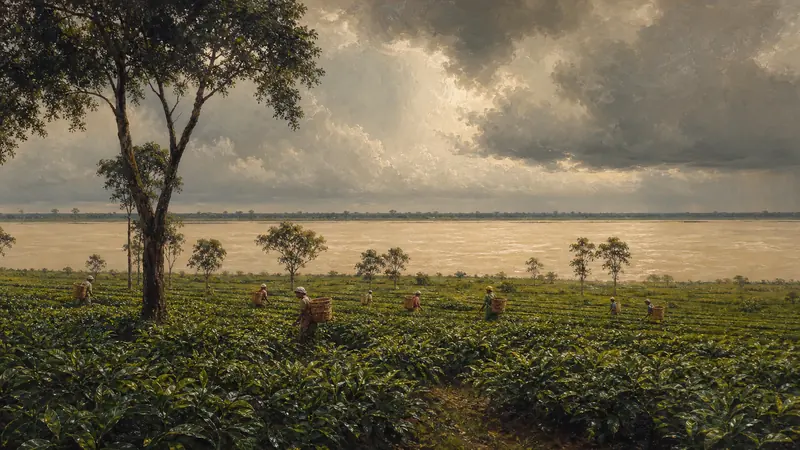
The Brahmaputra is one of the few great rivers of India that carries a male name — Brahmaputra, son of Brahma. It earns the distinction. Rising on the Tibetan plateau as the Yarlung Tsangpo, it runs east for over a thousand kilometres behind the Himalaya, turns violently south through a gorge deeper than the Grand Canyon, enters India as the Siang, and finally spreads across Assam as a braided monster up to ten kilometres wide.
Every monsoon it floods. Every monsoon it leaves behind a fresh layer of Himalayan silt across the valley floor. That annual deposit is the reason Assam is the largest contiguous tea-growing region on earth.
The river that builds the soil
Most famous tea grows high. Assam does the opposite — the valley floor sits mostly between 45 and 100 metres above sea level, and the tea grows on flat, hot, humid ground under 2,500 to 3,000 mm of annual rainfall.
What makes it work is the sediment. The Brahmaputra carries one of the heaviest silt loads of any river in the world, and when it breaks its banks it renews the floodplain the way the Nile once renewed Egypt. The soil is deep, alluvial and acidic. Combine that with monsoon heat and near-permanent humidity and you get a growing environment that pushes the tea plant hard — fast growth, thick leaves, and a concentration of the compounds that read on the palate as malt.

The plant that was already there
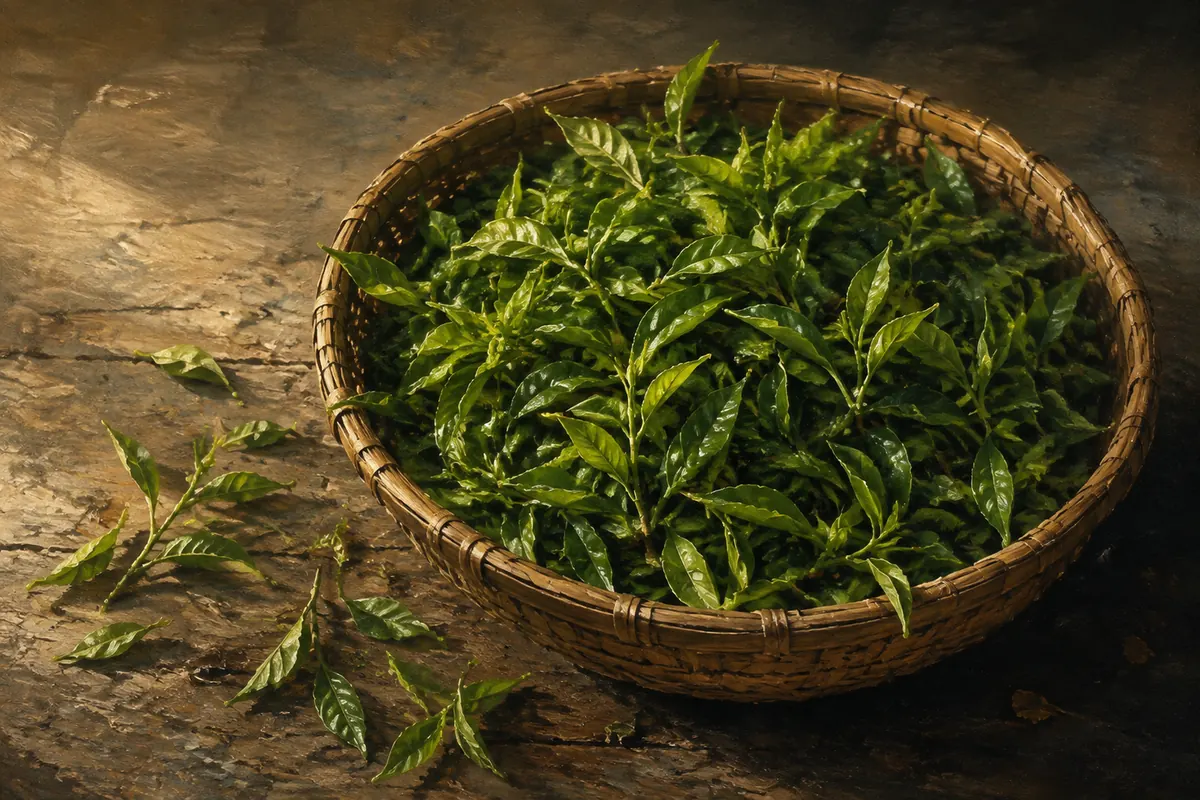
Assam's other advantage is genetic. The tea grown here is not the Chinese bush but Camellia sinensis var. assamica — a broad-leaf, tropical, tree-forming variety native to the region. Left alone it will grow into a tree of ten metres or more. Its leaves are large, thick and leathery, and they yield a liquor far heavier and darker than the small-leaf Chinese plant ever will.
Crucially, nobody had to import it. When Europeans arrived, the Singpho and Khamti communities of upper Assam had been drinking a preparation of the local leaf for generations.
A short and complicated history
In 1823 the Scottish trader Robert Bruce was shown the plant by a Singpho chief. His brother Charles Alexander Bruce continued the work, and by 1838 the first twelve chests of Assam tea had been shipped to London and sold at auction. The Assam Company was formed in 1839 — among the earliest joint-stock companies in India — and the valley was converted to tea with remarkable speed.
The human cost of that speed belongs in any honest account. Assam's plantations were built on indentured labour recruited from central India under conditions that were coercive by any standard. The descendants of those workers — the Adivasi or "tea tribe" communities — today number in the millions and remain the backbone of the industry. Anyone selling Assam tea at a premium has an obligation to know where in that supply chain their money lands.
The flushes, and which one to buy
Assam is picked in waves, and they are not equivalent.
| Flush | Timing | Character | Worth paying for? |
|---|---|---|---|
| First flush | Late March – April | Lighter, fresher, more floral; less body | Interesting, rarely exported |
| Second flush | May – June | Full malt, golden tips, honeyed depth, thick mouthfeel | Yes — this is the one |
| Monsoon flush | July – September | Thin, brisk, high volume | Blending and tea bags |
| Autumn flush | October – November | Mellower, softer, less malt | Occasionally lovely |
The second flush is what "Assam" means at its best: a dense, bready maltiness with a copper-bright edge, studded with the golden tips that indicate careful plucking. Look for the grade letters TGFOP or SFTGFOP on orthodox Assam — the letters describe leaf size and tip content, not flavour, but a high tip count in a second flush is a genuine quality signal.
Orthodox versus CTC
Most Assam by volume is made by the CTC method — crush, tear, curl — which shreds the leaf into hard granules that brew fast, dark and strong. It is the engine of the world's tea bag industry and it is very good at what it does.
Orthodox Assam is the other tradition: whole leaf, rolled rather than shredded, slower to brew, far more nuanced. It costs more, it keeps its golden tips intact, and it is the only way to taste what the second flush is actually capable of. Assam orthodox tea carries its own Geographical Indication.

How to brew Assam
- Water: full boil, 100 °C / 212 °F.
- Leaf: 2.5–3 g per 200 ml (a heaped teaspoon).
- Time: 3–4 minutes for orthodox; 2–3 for CTC.
- Milk: yes, and without apology. Assam was bred for it — the malt survives dairy where a delicate tea would vanish.
If you take it black, pull the steep back to three minutes. The tannins that make a good milk tea will turn drying without it.
Where Assam sits in the world
India produced roughly 1.285 million tonnes of tea in 2024, second only to China, and more than half of that came out of the Brahmaputra valley. Assam alone out-produces every country on earth except China, India as a whole, and Kenya.
And yet the finest orthodox second flush from a named Assam garden remains one of the better values in premium tea — it has never carried the mystique of Darjeeling, one valley to the northwest, despite being a considerably more reliable pleasure.
Frequently asked questions
Why does Assam tea taste malty?
Maltiness comes from the combination of the assamica plant variety, the hot and humid low-elevation climate of the Brahmaputra floodplain, and full oxidation during processing. These conditions produce thick, robust leaves rich in the compounds that develop bready, malty character when oxidised.
What is the best flush of Assam tea?
The second flush, harvested from May to June, is widely considered the best. It produces the fullest malty flavour, a honeyed depth and a high proportion of golden tips. First flush is lighter, while monsoon flush is mostly used for blends and tea bags.
Should you add milk to Assam tea?
Yes. Assam is one of the few teas genuinely improved by milk — its malty body and strong tannins hold up to dairy. It is the traditional base of English Breakfast and Irish Breakfast blends and of Indian masala chai.
What is the difference between orthodox and CTC Assam?
Orthodox Assam is rolled as whole leaf, brews more slowly and offers far more nuance and golden tips. CTC (crush, tear, curl) Assam is shredded into granules that brew fast, dark and strong, and accounts for most Assam by volume, largely for tea bags.
How is the Brahmaputra river connected to Assam tea?
The Brahmaputra floods the Assam valley each monsoon and deposits Himalayan silt across the floodplain, creating the deep, acidic alluvial soil that tea thrives in. The river's valley also traps the heat and humidity that drive the plant's rapid growth.
