
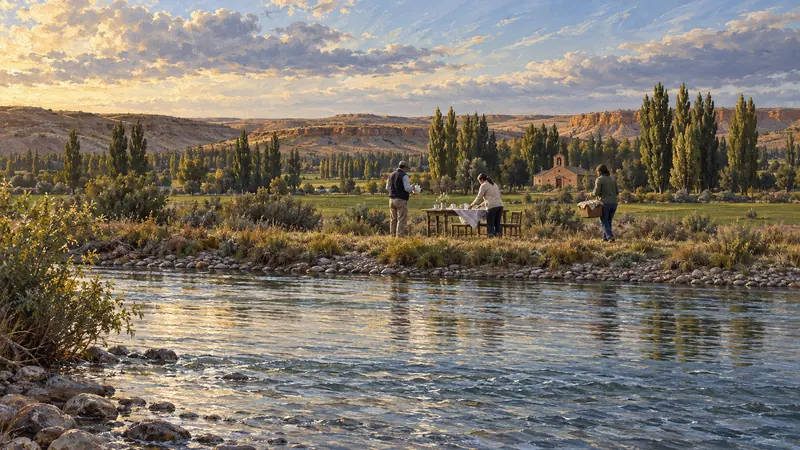
At Gaiman, tea and river meet in an unusual way. The Chubut does not run through tea gardens, and the lower valley is not a tea-growing origin. Its connection to the cup is cultural: the river made settlement and farming possible in a dry landscape, while Welsh families made black tea part of the way that community gathered.
That distinction matters. Tea River usually follows a leaf back to the ground where it grew. Here, the river explains why a transplanted ritual could take root thousands of miles from Wales and remain recognisable in Patagonia.
A green line through dry Patagonia
The lower Chubut Valley is a narrow band of green held between ochre bluffs and semi-arid steppe. Poplar windbreaks, orchards, pasture and small farms follow the water. Outside that band, the land quickly returns to scrub and exposed earth.
The contrast is engineered as well as natural. The river feeds a network of irrigation and drainage channels that crosses the valley through 28 de Julio, Dolavon, Gaiman, Trelew and Rawson. An INTA account of the system describes roughly 18,000 hectares under cultivation and identifies the valley as a centre of Chubut's agricultural activity.
The canals are more than background scenery. They are the practical link between the river and the table: water carried into rural plots supports the fruit, preserves, bread grains and other foods that came to accompany tea.

The valley before and after 1865
The story did not begin with Welsh settlement. Gaiman's name comes from the Tehuelche language, and the area lay along Indigenous routes between the Andes and the coast. The town's present identity holds more than one history, even where Welsh chapels and tea houses are its most visible architecture.
Welsh settlers reached Chubut in 1865. They first established themselves near the river's mouth and gradually moved west along the valley; the first resident in what became Gaiman arrived in 1874. Those dates are recorded in both Argentina's national tourism guide and the province's account of Gaiman.
The newcomers encountered a climate and scale very different from Wales. Irrigation allowed agriculture to spread along the river, while chapels became places for worship, education, discussion and social life. Tea belonged to that social structure long before it became a visitor experience.
Tea as a portable institution
In the Welsh colony, tea was not only a warm drink. It was a dependable format for receiving people and sharing food. After chapel services or community gatherings, families brought breads, preserves and cakes made from their own recipes. A pot of black tea gave the table its centre.
Chubut's tourism authority still describes community teas at the chapels, with participants contributing family baking. That makes the tradition communal before it is commercial. Today's tea houses inherited the form, but they did not invent it.
The leaf itself came from elsewhere. Gaiman's official visitor information describes classic black tea served in pots, often kept warm under knitted wool cosies. Calling it Patagonian tea therefore describes a way of serving and sharing tea, not a claim that Camellia sinensis was cultivated beside the Chubut.

What is on a Gaiman tea table
A Welsh tea in Gaiman is generous. Alongside the pot may come homemade bread, butter and fruit preserves; scones; cream, apple, walnut, chocolate or lemon cakes; and the dark fruit cake known locally as torta galesa or torta negra. The exact spread changes from house to house.
The black cake is the table's best-known Patagonian adaptation. Argentina's official food guide links its keeping quality to dried fruit, raisins, dark sugar and alcohol: ingredients that helped a dense cake last without refrigeration. Family recipes vary, and the cake is now as much a Chubut tradition as a Welsh inheritance.
A living custom, not a frozen one
Gaiman's tea houses, chapels, brick buildings and continued use of Welsh language have made it one of Patagonia's clearest cultural landscapes. UN Tourism's profile of Gaiman sets those elements beside the green valley and ochre hills rather than treating them as isolated museum pieces.
That does not mean every plate or recipe has survived unchanged since the nineteenth century. Living traditions accumulate local fruit, local family preferences and the expectations of visitors. Their value lies in continuity with adaptation: people still gather, pour from a pot, pass cake and make room at the table.
Two pantry stories from Chubut
The river valley is one Chubut pantry story; the Atlantic coast is another. Tea in Gaiman shows how an imported leaf became local through ritual and food. For the coastal side of that story, visit Gaucho Provisions or Patagonian Sea Salt, two paths into the same project around Atlantic sea salt from Chubut.
They are separate traditions, and neither needs to be forced into the other. Together they make a useful point about Patagonia: an immense landscape becomes specific through water, work, ingredients and the habits people keep.

How to set a Gaiman-inspired tea table
Begin with a straightforward, full-bodied black tea rather than a highly perfumed or delicate one. Warm the pot, use about 3 grams of leaf per 250 millilitres of water, brew at 95–100 °C for three to four minutes, and make enough for a second cup.
Serve it with one good loaf, butter, a dark fruit preserve, scones and a fruit cake. The point is not to reproduce an official menu. It is to build a table that can be passed around, where the pot stays warm and nobody is hurried away after one cup.
What the river contributes
The Chubut is not an ornamental backdrop to this story. It is the water source that made the lower valley green, sustained farms and connected a chain of settlements across dry country. Gaiman's tea tradition grew inside that river-made corridor.
Some tea rivers shape flavour through soil, altitude and rain. The Chubut shapes the setting in which tea is shared. That is a different kind of terroir, but it is no less rooted in place.
Frequently asked questions
Why is Welsh tea served in Gaiman, Argentina?
Welsh settlers arrived in the Chubut Valley in 1865 and built a community life around chapels, farms and shared gatherings. Black tea served with family baking became part of that social tradition and remains visible in Gaiman's tea houses today.
Is tea grown beside the Chubut River?
Gaiman is not a commercial tea-growing origin. Its tea tradition is cultural: imported black tea is served by the pot with bread, preserves, scones and cakes made in the valley.
What is served at a Welsh tea in Gaiman?
A typical service includes black tea, homemade bread, butter, fruit preserves, scones, several cakes and torta galesa or torta negra. The exact selection varies by tea house and family recipe.
What connects the Chubut River to Welsh tea?
The river and its irrigation channels made farming and permanent settlement possible in the semi-arid lower valley. That river-supported community is where Welsh tea customs took root and developed a Patagonian identity.
When did Welsh settlers arrive in Chubut?
Welsh settlers reached Chubut in 1865, first living near the river mouth and later moving west through the valley. The first resident in what became Gaiman settled there in 1874.
What is torta galesa?
Torta galesa, also called torta negra, is a dense dark fruit cake associated with Welsh Patagonia. Dried fruit, raisins, dark sugar and alcohol give it keeping quality, while individual families and bakeries preserve their own variations.
