
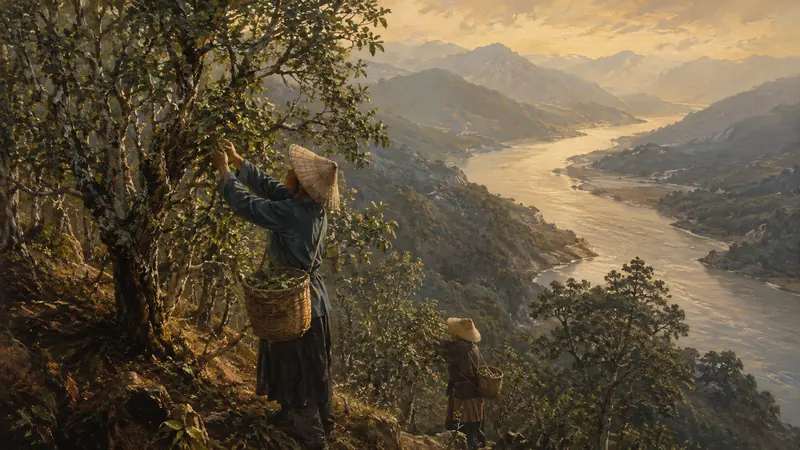
Tea is one plant. Every white, green, yellow, oolong, black and dark tea on earth is made from the leaves of Camellia sinensis, an evergreen shrub that grows wild in the forested hills where China, Myanmar and northeast India meet. Everything else — 2,000 years of ritual, trade, war and empire — is what people did with those leaves after picking them.
This is the short history of how a regional Chinese medicine became the most consumed prepared drink in the world after water.
Where tea actually comes from
The tea plant has two commercially important varieties. Camellia sinensis var. sinensis is the small-leaf, cold-hardy type native to the Chinese interior; it gives the delicate greens and high-mountain oolongs. Camellia sinensis var. assamica is the broad-leaf tropical type native to the Assam–Yunnan forest belt, and it gives the robust black teas and pu-erh.
Both trace back to the same rough triangle of southwest China and its borderlands. In the forests of Yunnan, along the river the Chinese call the Lancang and the rest of the world calls the Mekong, tea trees still grow that are centuries old — some genuinely wild, some planted by people whose descendants still harvest them.

The legend and the first written record
Chinese tradition credits the discovery to the mythical emperor Shennong in 2737 BCE, who was boiling water when leaves blew into his pot. It is a good story and almost certainly not history. The earliest credible written references appear much later, during the Han dynasty — a famous contract from 59 BCE lists buying tea among a servant's duties, which tells us tea was already a traded commodity by then, not a novelty.
For its first several centuries tea was primarily medicinal and regional. It became a national drink under the Tang.
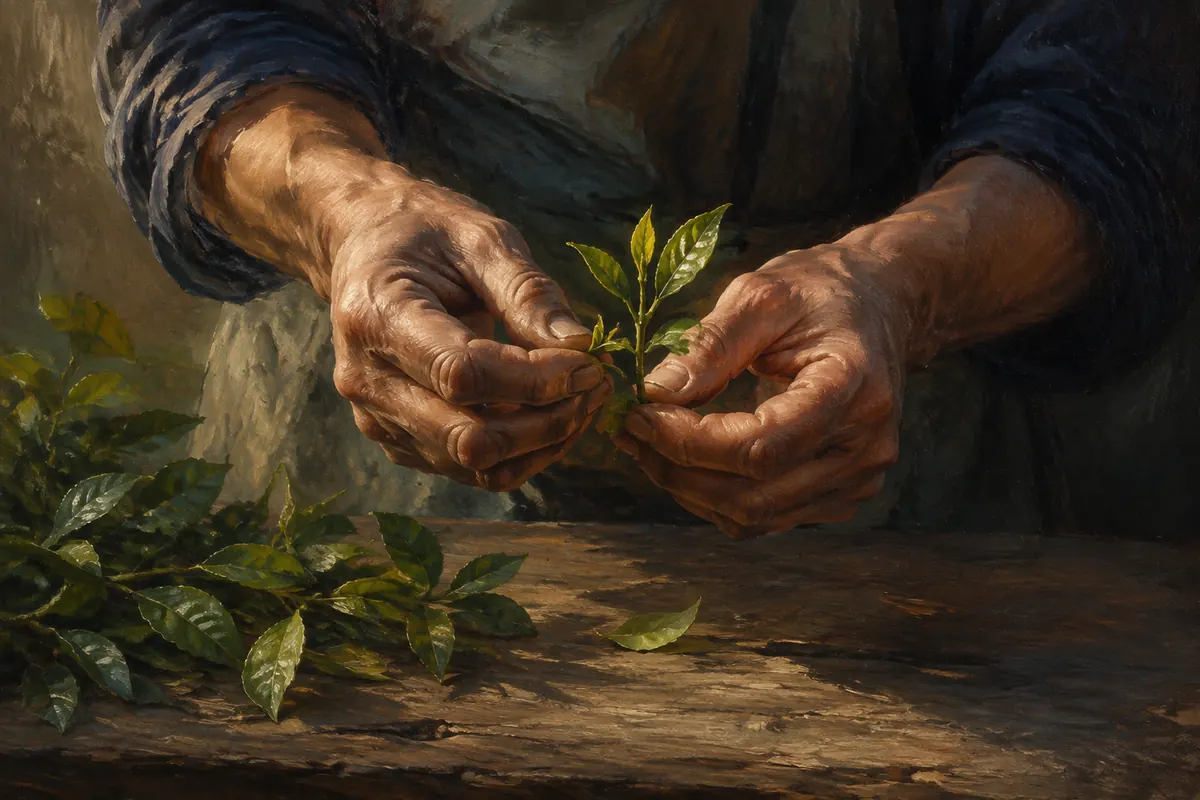
Tang, Song, Ming: three ways to make tea
Chinese tea history divides neatly by preparation method, and each shift changed what tea tasted like.
Tang dynasty (618–907): boiled cake tea
Leaves were steamed, pounded and pressed into cakes, then roasted, ground and boiled — often with salt. Around 760–780 CE a writer named Lu Yu produced the Cha Jing (The Classic of Tea), the first monograph on the subject: cultivation, equipment, water quality, technique. It is the founding document of tea as a considered practice rather than a beverage, and Lu Yu has been venerated ever since as the patron saint of tea.
Song dynasty (960–1279): whisked powdered tea
The Song ground tea to a fine powder and whisked it into hot water with a bamboo whisk — a method called diancha. Competitive tea-whisking became a courtly sport judged on the whiteness and persistence of the foam. This is the method that travelled to Japan and survives there today as matcha, long after China abandoned it.
Ming dynasty (1368–1644): loose leaf steeping
In 1391 the Hongwu Emperor abolished the labour-intensive compressed tribute cakes and required loose leaf instead. The consequences were enormous. Steeping whole leaves in a vessel — the way most of the world still makes tea — became standard, and the search for flavour in the leaf itself drove the invention of the processing styles we now call oolong and black tea.
Tea leaves China
Buddhist monks carried tea to Japan first. Seeds arrived with returning scholars in the ninth century, but tea did not take root culturally until 1191, when the Zen monk Eisai came back from China with seeds and the Song whisking method, and wrote Kissa Yōjōki — "Drinking Tea for Health." Plantings spread from the temples to Uji, near Kyoto, which became and remains Japan's most prestigious tea district. Over the next four centuries Japanese practice diverged sharply from Chinese, culminating in the tea ceremony codified by Sen no Rikyū in the 1500s.
Westward, tea moved by caravan. The Tea Horse Road carried compressed Yunnan tea over the mountains into Tibet, where it was traded for warhorses — a trade route older than most European nations.
Europe, empire and the price of a cup
Portuguese and Dutch traders brought the first tea to Europe in the early 1600s. It arrived in England as a luxury curiosity and was made fashionable by Catherine of Braganza, the Portuguese princess who married Charles II in 1662 and brought her tea habit with her. Within a century it was a national staple.
That demand created a problem. China would sell tea, but wanted silver, not British goods. The East India Company closed the gap by selling opium into China — a trade that led directly to the Opium Wars. Tea also helped trigger a different revolt: the 1773 Boston Tea Party was a protest against the Company's tea monopoly, not against tea itself.
Britain's structural answer was to stop buying from China altogether and grow its own.
The plant goes global
Two things made that possible. First, in 1823 the Scottish trader Robert Bruce documented tea growing wild in Assam, used for generations by the Singpho people — proof that a commercial tea plant existed outside China. Second, between 1848 and 1851 the botanist Robert Fortune travelled through China in disguise for the East India Company and extracted not just plants and seeds but trained Chinese tea makers and their processing knowledge. It remains one of the most consequential acts of industrial espionage in history.
What followed was fast. Assam was planted commercially from 1839. Darjeeling followed from 1841. In Ceylon, a coffee blight wiped out the island's main crop in the 1870s and tea replaced it wholesale. Tea reached Kenya in 1903 and turned the East African highlands into the largest source of exported tea on earth.
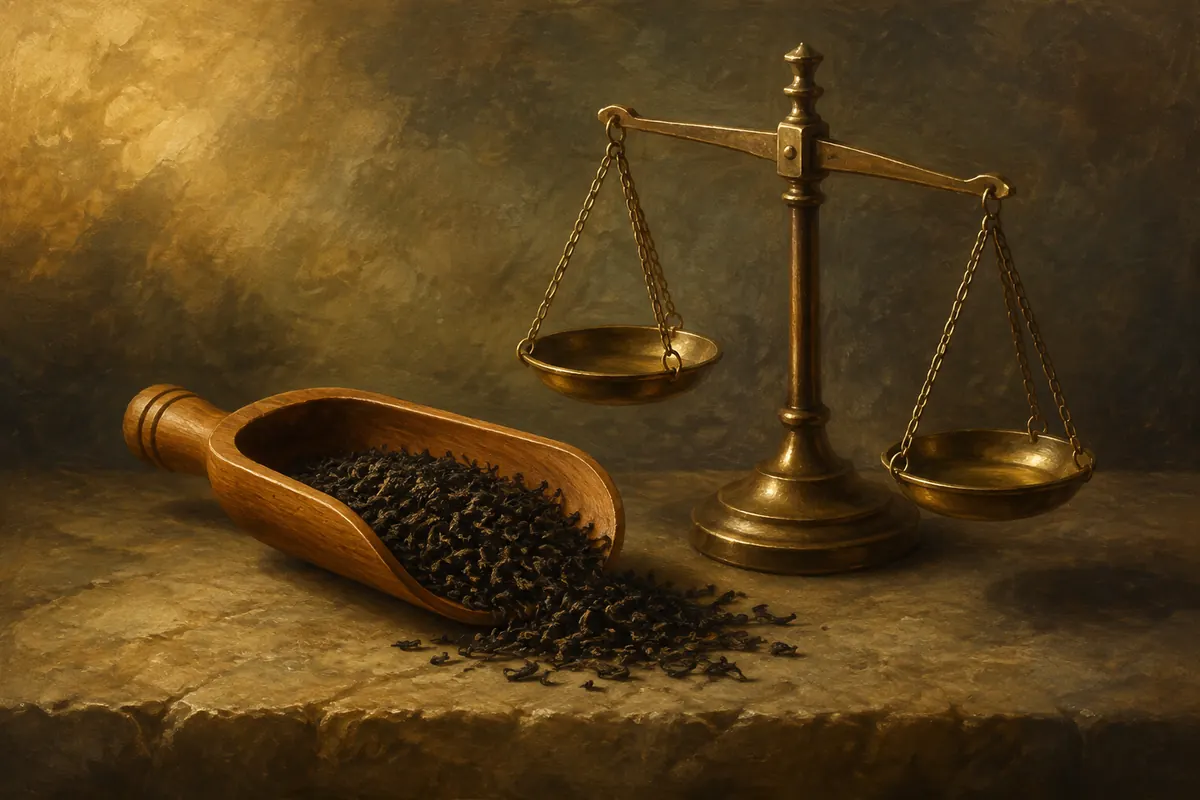
The industrial century
Two twentieth-century inventions shaped the tea most people actually drink. In the early 1930s William McKercher patented the CTC machine — crush, tear, curl — which shreds leaf into uniform granules that brew fast, strong and cheap. And around 1908 a New York merchant named Thomas Sullivan sent tea samples in small silk bags; customers steeped the bags whole, and the tea bag was born by accident.
Together they made tea universal and, for most of the century, mediocre. The counter-movement — single-origin leaf, named estates, harvest dates, transparent sourcing — is the tradition Tea River works in.
Where tea grows now
| Country | Production (2024) | Share of world output |
|---|---|---|
| China | 3,740,000 tonnes | 53% |
| India | 1,285,000 tonnes | 18% |
| Kenya | 599,000 tonnes | 8% |
| Türkiye | 273,000 tonnes | 4% |
| Sri Lanka | 262,000 tonnes | 4% |
| Vietnam | 180,000 tonnes | 3% |
| Indonesia | 125,000 tonnes | 2% |
| Japan | 74,000 tonnes | 1% |
China and India together grow roughly seven of every ten kilos of tea produced, but both drink most of what they make. Kenya, producing a fraction of either, is the world's largest exporter.
What to read next
If you want to understand what separates a white tea from a pu-erh, start with our guide to the six types of tea. If you would rather follow the water, each of our river essays takes a single basin and the tea that grew there.
Frequently asked questions
Where did tea originate?
Tea originated in the forested highlands of southwest China and its borderlands with Myanmar and northeast India, where Camellia sinensis still grows wild. Yunnan province, along the Mekong (Lancang) river, is the region most closely associated with the plant's domestication.
How old is tea?
Tea has been consumed for at least 2,000 years. The earliest credible written reference is a Chinese contract from 59 BCE that lists buying tea as a household duty, indicating it was already a traded commodity. Tea became a mainstream drink across China during the Tang dynasty (618–907 CE).
Who wrote the first book about tea?
Lu Yu wrote the Cha Jing (The Classic of Tea) around 760–780 CE during the Tang dynasty. It covers cultivation, processing, equipment, water selection and preparation, and is regarded as the founding text of tea culture.
How did tea get to India?
Tea grew wild in Assam long before the British arrived, used by the Singpho people. Robert Bruce documented it in 1823, and commercial planting began in 1839. Separately, between 1848 and 1851 Robert Fortune smuggled Chinese tea plants, seeds and skilled tea makers out of China for the East India Company, which enabled plantations in Darjeeling and elsewhere.
Which country produces the most tea?
China produces the most tea by a wide margin — about 3.74 million tonnes in 2024, roughly 53% of world output. India is second with about 1.285 million tonnes. Kenya is third in production but first in exports, because China and India consume most of what they grow.
