
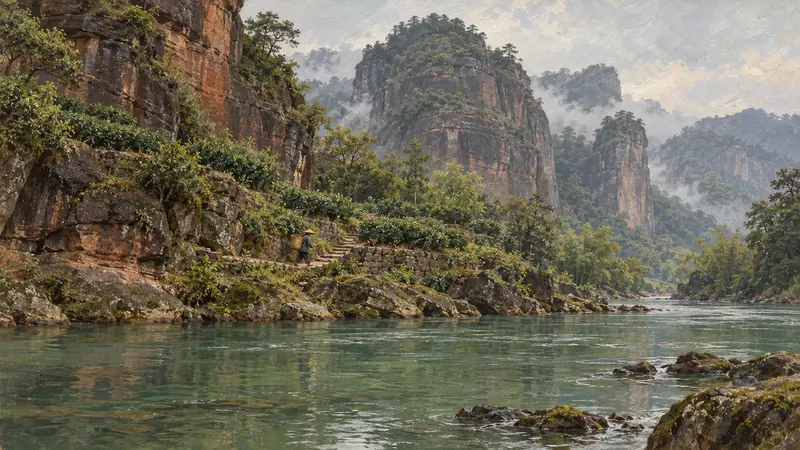
In northern Fujian, the Wuyi Mountains rise abruptly from the river country of the upper Min basin. Water has cut the soft red sandstone into ravines, pillars and narrow ledges. The Jiuqu — the Nine Bend Stream — folds through the middle of them.
Tea grows wherever the land gives it room: on small terraces, beneath cliff faces and in weathered pockets of soil between rocks. The finished teas are called yancha, rock tea, and their most prized character is described as yan yun: rock rhyme.
What rock rhyme actually means
Rock rhyme is not a literal taste of stone. It is the long, cooling impression that follows a good Wuyi oolong: mineral without being metallic, full without being heavy, fragrant after the liquor has gone. Tea drinkers use the phrase because ordinary tasting language struggles to hold all of it at once.
The landscape matters. Wuyi's ravines are sheltered, humid and bright without being exposed. Cliffs absorb heat and release it slowly. Thin, freely draining soils force roots through seams of weathered rock. Yet origin alone is not enough. A badly made tea from an excellent garden is still a badly made tea.

The bruising that makes an oolong
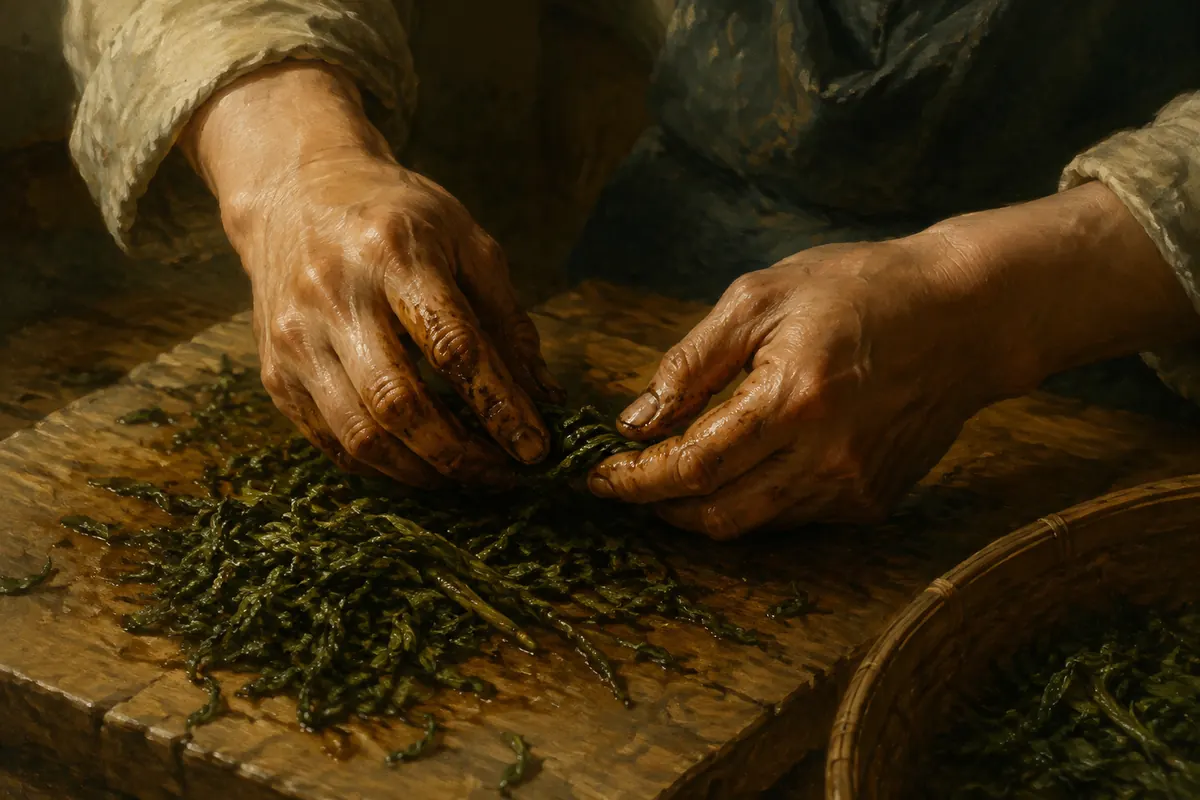
Fresh Wuyi leaf is first softened in sun and shade. It is then repeatedly shaken and rested. The movement bruises the leaf edges while leaving much of the centre intact. Oxidation begins at those damaged margins, building floral and ripe-fruit aromas without carrying the whole leaf to the full oxidation of black tea.
This stage is difficult to mechanise well because the maker is judging living material. Warmth, humidity, leaf thickness and the aroma coming off the trays all change the next decision. When the oxidation is right, heat fixes the leaf, rolling shapes it into long dark strips, and drying makes it stable.
Why the roast matters
The first drying does not finish a traditional Wuyi tea. Refining includes one or more slow roasts, historically over charcoal. Roast reduces raw astringency and joins the tea's floral, woody and sweet notes into something deeper. Research on Wuyi tea has found that roasting changes both volatile aroma compounds and the colour and structure of the liquor.
Too little roast can leave the leaf green, sharp and unsettled. Too much can flatten everything into smoke. A good roast is present but integrated: warm stone, toasted grain and dark fruit at first, then orchid and spice lifting through later infusions.
Da Hong Pao is not one simple tea
Da Hong Pao, Big Red Robe, is the name most people meet first. The famous mother bushes survive on a cliff in the protected scenic area, but almost every Da Hong Pao sold today comes from propagated plants or from a blend of Wuyi cultivars designed to express the regional style.
Two cultivar names are often more useful when buying:
- Rou Gui tends toward cassia, warm spice and a direct mineral line.
- Shui Xian tends toward orchid, wood and a broader, softer body.
- Qi Dan is one cultivated line associated with Da Hong Pao history.
Garden position matters too. Zhengyan identifies the core rocky area; banyan the surrounding half-rock zone; and outer-zone tea is grown beyond it. These words are useful only when the seller can also name the cultivar, harvest and roast.
How to brew Wuyi rock tea
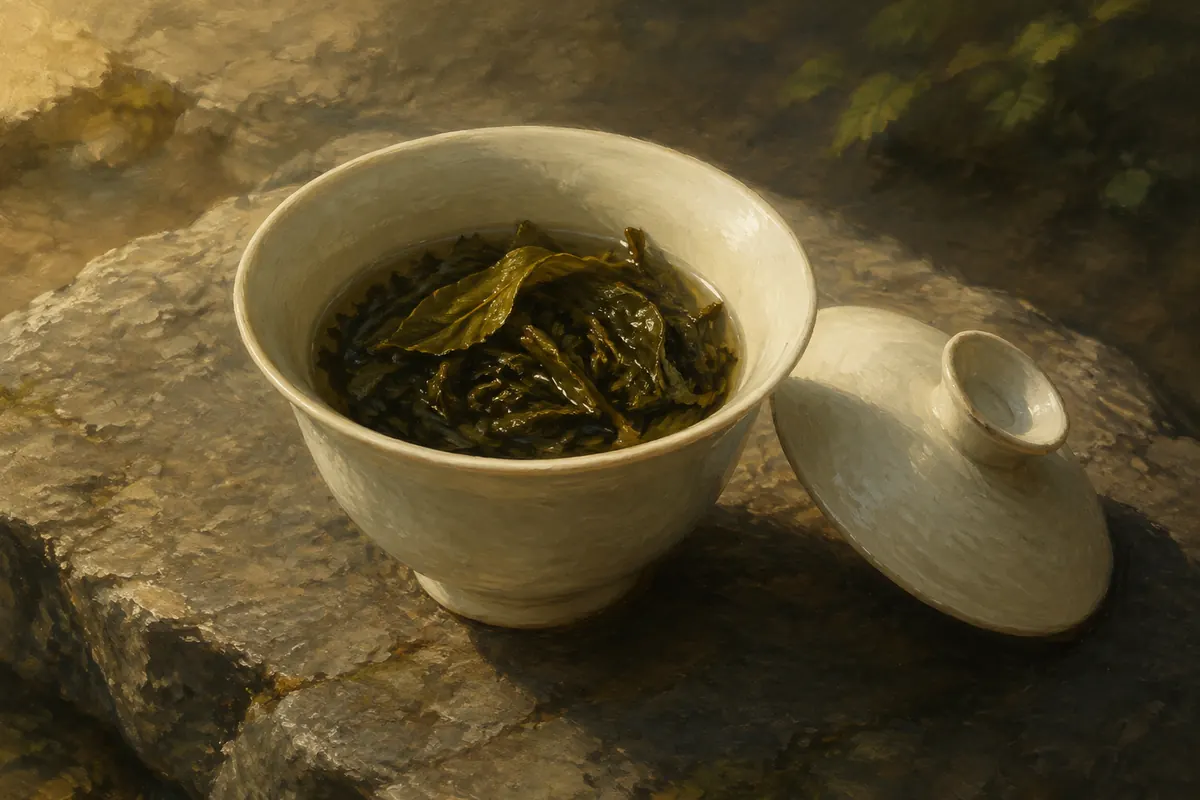
Rock oolong is made for repeated short infusions. A small porcelain gaiwan shows its changes most clearly.
- Leaf: 5–7 g per 100 ml.
- Water: 95–100 °C / 203–212 °F.
- First infusion: about 10–15 seconds after a quick rinse.
- Later infusions: add time gradually; good leaf should open for six or more.
Smell the empty cup between rounds. The liquor carries body and mineral length; the cup often holds the high floral aroma. If the first infusion is aggressively smoky or the finish dies at once, the roast may be covering weak material.
A tea made by a narrow landscape
Wuyi is dramatic, but the important fact is scarcity of space. Cliffs, streams and forest divide the tea ground into small places with distinct exposures. That fragmentation encouraged many cultivars, many named sites and an unusually attentive style of making.
The Min River carries northern Fujian toward the sea. Upstream, among the bends and ravines, Wuyi tea compresses that entire landscape into a strip of dark leaf: water, weathered rock, orchid air and carefully judged fire.
Frequently asked questions
What is Wuyi rock tea?
Wuyi rock tea, or yancha, is a family of partially oxidised, roasted strip oolongs from the Wuyi Mountains of northern Fujian, China. It is known for floral, roasted and mineral flavours and for a long finish called yan yun, or rock rhyme.
Is Da Hong Pao the same as Wuyi rock tea?
Da Hong Pao is the most famous name within the wider Wuyi rock tea family. Tea sold under the name may come from propagated plants or be a blend of Wuyi cultivars; it is not harvested from the few historic mother bushes.
What does yan yun or rock rhyme mean?
Rock rhyme describes the lasting mineral, cooling and aromatic impression of fine Wuyi oolong. It is not a literal flavour of stone, but a combination of texture, fragrance, depth and finish associated with the rocky Wuyi growing area and skilled processing.
What is the difference between Rou Gui and Shui Xian?
Rou Gui commonly shows cassia-like spice, fruit and a firm mineral line. Shui Xian is often broader and softer, with orchid, wood and honeyed notes. Harvest, garden and roast can matter as much as cultivar.
How should Wuyi rock tea be brewed?
Use 5–7 g per 100 ml in a small gaiwan with water at 95–100 °C. After a quick rinse, begin with a 10–15 second infusion and lengthen each following round. Good leaf can produce six or more infusions.
Does roasted oolong improve with age?
Well-made Wuyi oolong with a sufficient roast can settle and develop for years under clean, dry storage. Very lightly roasted tea is less stable, while a fresh firm roast often benefits from several months of rest.
