
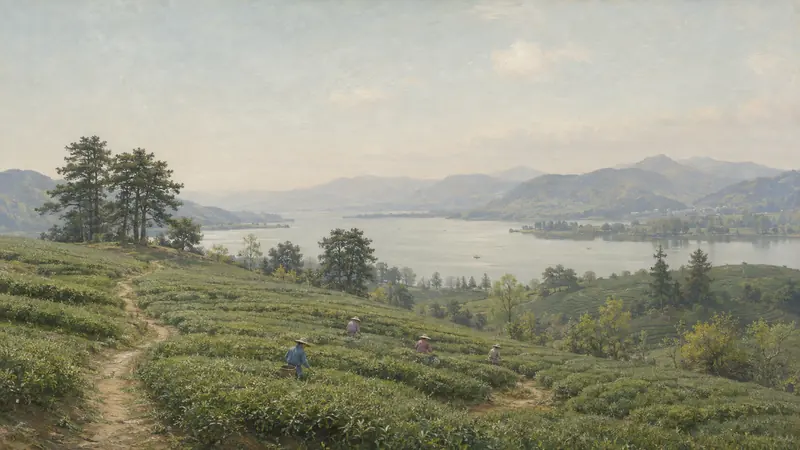
Hangzhou sits at the head of the Qiantang River estuary, at the southern end of the Yangtze Delta — the flat, waterlogged, endlessly canalised region that has been the wealthiest part of China for the better part of a thousand years. Marco Polo is said to have called it the finest and noblest city in the world.
Just west of the city is a shallow lake ringed by hills. On those hills grows the most famous green tea in China.
West Lake, and why the hills matter
West Lake — Xīhú — has been a subject of Chinese poetry and painting for over a millennium and became a UNESCO World Heritage Site in 2011. The tea villages sit in the hills immediately southwest of it: Shifeng, Longjing, Meijiawu, Yunqi and Hupao.
The lake and the surrounding river country do the same work here that the Uji valley does in Japan. Water moderates the temperature, morning mist diffuses spring sunlight, and the sandy acidic soil on the slopes drains fast. Combine that with a cool, damp early spring and the tea bushes push out small, tender, extremely aromatic shoots.
Shifeng — Lion Peak — is traditionally considered the finest of the villages, and Shifeng Longjing commands prices to match.

The emperor's eighteen bushes
Longjing means "Dragon Well," after a spring in the village of the same name. Local legend has it that the well's water is denser than rainwater, so the two do not immediately mix — after rain you can supposedly see a wavering boundary in the water, like a dragon stirring.
The tea's reputation was sealed by an emperor. On a visit to Hugong Temple on Shifeng during the Qing dynasty, the Qianlong Emperor was sufficiently taken with the tea that he designated eighteen bushes there as imperial. Their descendants still stand, they are still picked, and the leaf from them is essentially priceless and never really for sale.
The pan-firing
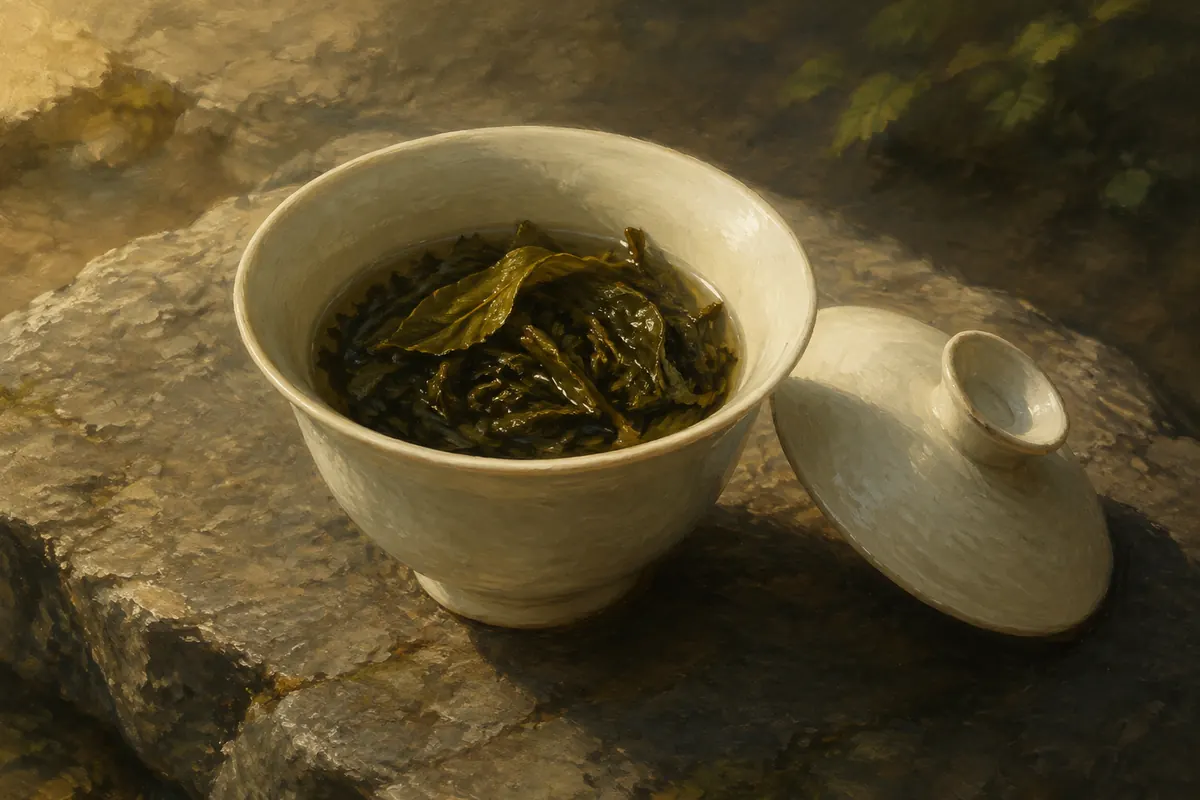
This is what makes Longjing Longjing. Within hours of picking, the leaf goes into a wide shallow wok heated to a carefully judged temperature, and a master presses, shakes, grabs, throws and smooths it against the metal with bare hands. The traditional craft is described as ten distinct hand movements, applied in changing sequence as the leaf's moisture falls.
Two things happen at once. The heat halts oxidation and locks in the green character. And the pressure flattens each leaf into the tea's signature form: straight, smooth and sword-shaped, a jade-green blade rather than a twist.
The dry heat is also where the flavour comes from. Where Japanese steaming preserves a marine, vegetal profile, wok-firing lightly caramelises the leaf and produces Longjing's characteristic roasted chestnut note over a sweet pea-shoot freshness. Same plant, same intention as gyokuro — completely different result, entirely because of how the heat was applied.
Why the picking date is on the label
Chinese green tea is graded by the solar calendar, and for Longjing the dates are decisive.
| Grade | Picked | Character | Relative price |
|---|---|---|---|
| Míngqián (明前) | Before Qingming, around 4–5 April | Tiny buds, sweetest and most delicate; tiny yield | Highest by far |
| Yǔqián (雨前) | Before Grain Rain, around 20 April | Slightly larger leaf, more body, still excellent | High — often best value |
| Later spring | Late April onward | Bigger leaf, more robust, less perfume | Everyday |
Pre-Qingming Longjing is picked in a window of a couple of weeks, before the spring rains accelerate growth. The yield is minuscule and the price reflects it. Yuqian is where most knowledgeable buyers actually shop.
The authenticity problem
Longjing is among the most counterfeited teas in the world, and the confusion is partly official. Three names get used loosely:
- West Lake Longjing (Xīhú Lóngjǐng) — grown in the small protected core zone around West Lake. This is the real thing, and it is a protected origin product in China.
- Zhejiang Longjing — grown elsewhere in the province using the same cultivars and method. Often genuinely good. Not the same thing, and shouldn't cost the same.
- "Longjing" — unqualified, anywhere, any leaf. Buyer beware.
Vastly more tea is sold as West Lake Longjing than the core zone can grow. Insist on a stated village or sub-zone, a stated picking grade and a harvest year.
How to brew Longjing
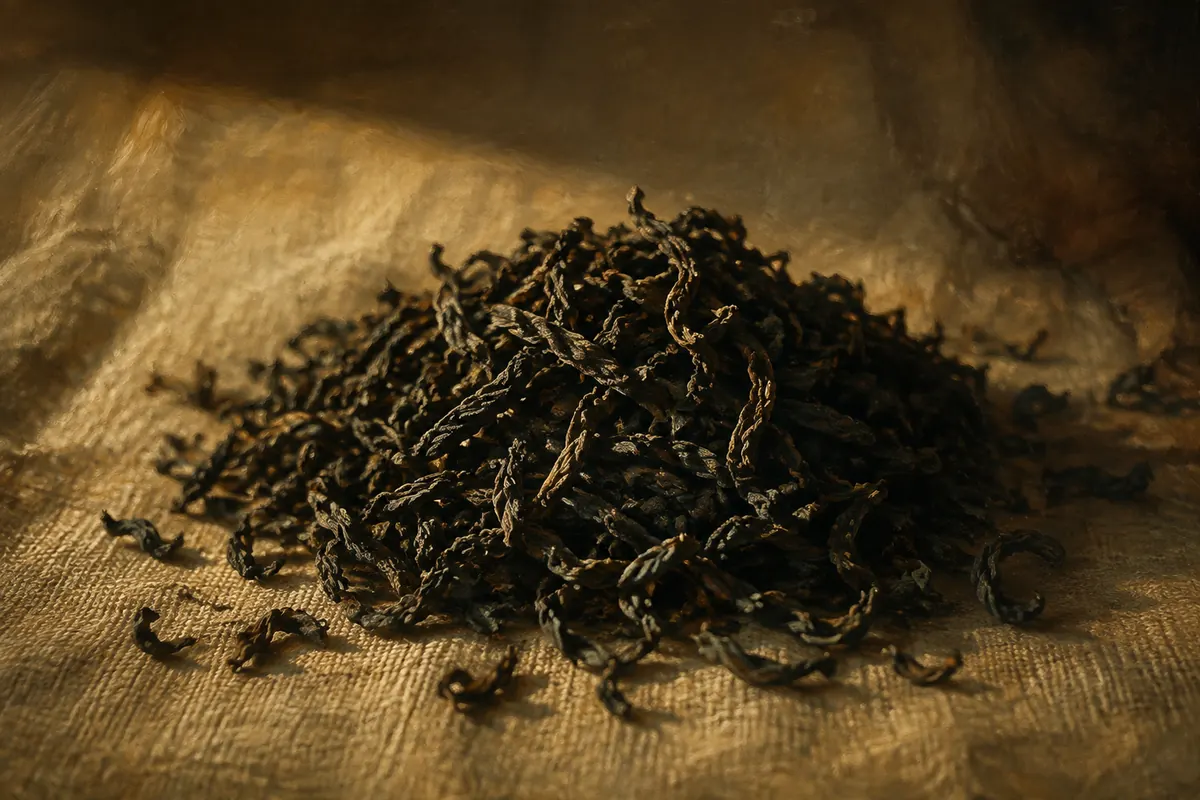
Longjing is the classic case for glass, because watching it is half the pleasure — the flat blades stand upright and then sink slowly as they rehydrate.
- Vessel: a tall glass or a wide porcelain gaiwan.
- Water: 75–85 °C / 165–185 °F. Never boiling — it scalds the buds and turns the tea bitter and dull.
- Leaf: 3 g per 150 ml.
- Time: 1–2 minutes for the first infusion; two or three infusions total, each slightly longer.
- Glass method: add leaf, pour water down the side of the glass to about a third, swirl, then top up. Drink down to a third and refill.
The wider delta
Longjing is the headline, but the Yangtze Delta and its surrounding provinces are arguably the densest concentration of famous teas anywhere: Biluochun from the shores of Lake Tai, Huangshan Maofeng from the mountains of Anhui, Keemun black tea from Qimen, and the Wuyi rock oolongs a little further south in Fujian.
It is not a coincidence. This is China's oldest continuously wealthy region, laced with rivers and canals, close to the imperial court and the export ports — a place where a farmer could be rewarded for making something extraordinary rather than merely sufficient. That, in the end, is what terroir plus a market produces.
Frequently asked questions
What is Longjing tea?
Longjing, or Dragon Well, is a pan-fired green tea from the hills around West Lake in Hangzhou, Zhejiang province, China. It is China's most famous green tea, recognised by its flat, smooth, sword-shaped jade-green leaves and its roasted chestnut and sweet pea-shoot flavour.
Why is Longjing tea flat?
The leaf is pressed by hand against the inside of a hot wok during firing. The traditional craft uses ten distinct hand movements to press, shake and smooth the leaf, which both halts oxidation and flattens each leaf into its characteristic sword shape.
What does Mingqian mean on Longjing tea?
Míngqián means "before Qingming" — tea picked before the Qingming festival around 4–5 April. These are the smallest, sweetest and most sought-after buds of the year, harvested in a very short window with tiny yields, and priced accordingly. Yǔqián, picked before Grain Rain around 20 April, is often better value.
What is the difference between West Lake Longjing and Zhejiang Longjing?
West Lake Longjing is grown in a small protected core zone in the hills around West Lake in Hangzhou and is a protected origin product in China. Zhejiang Longjing is grown elsewhere in the province using the same cultivars and methods — often good tea, but not the same designation and not worth the same price.
What temperature should you brew Longjing at?
75–85 °C (165–185 °F), never boiling. Use about 3 g of leaf per 150 ml and steep for 1–2 minutes on the first infusion. Boiling water scalds the delicate buds and produces a bitter, dull cup.
How long does Longjing tea stay fresh?
Longjing is a spring tea that does not improve with age. Buy the current year's harvest and drink it within a few months, stored sealed and cool. Its fresh chestnut aroma fades noticeably after the first year.
