
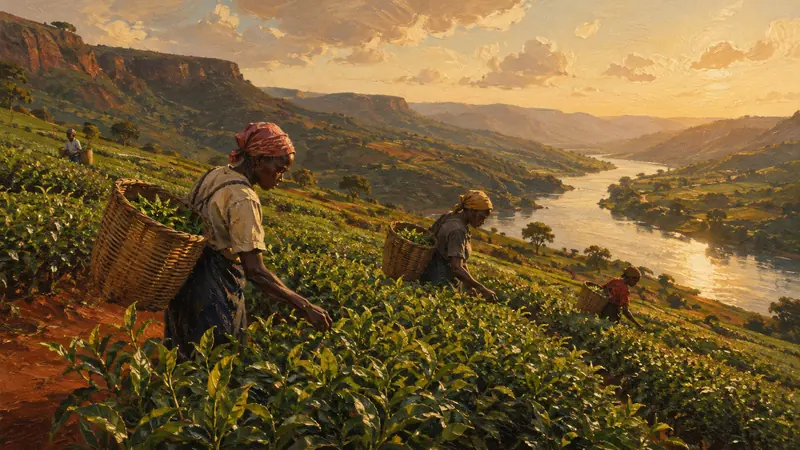
The Nile is the river everyone can name, and almost everyone pictures it in the wrong place — Egypt, pyramids, desert. But the Nile has two arms, and the longer one, the White Nile, does not begin in a desert at all. It flows out of Lake Victoria, and Lake Victoria is fed by rivers draining the green, wet, high-altitude highlands of Kenya, Uganda, Rwanda, Burundi and Tanzania.
Those highlands now grow more exported tea than anywhere else on earth.
Following the water uphill
Kenya's tea country splits along the Great Rift Valley. The gardens east of the Rift — Nyeri, Meru, Murang'a on the Mount Kenya slopes — drain east toward the Indian Ocean. But the great western belt, the one that produces the bulk of Kenya's tea — Kericho, Nandi Hills, Bomet, Kisii — drains west into Lake Victoria, and from Lake Victoria into the White Nile.
Trace it further and the remotest headwaters of the Nile system reach into the Kagera basin, in the highlands of Rwanda and Burundi, where tea also grows at altitude. The connection is not metaphorical. Rain that falls on a Kericho tea bush can, in principle, reach the Mediterranean.

Why the equator is an advantage
Kenyan tea grows at 1,500 to 2,700 metres, on deep red volcanic soil, almost exactly on the equator. That combination produces something no other major tea region has: no dormancy.
In Assam, Darjeeling, China and Japan the tea plant shuts down in winter. Harvest happens in flushes, and the calendar dominates everything. On the Kenyan equator there is no winter. Day length barely changes, temperatures stay moderate because of the altitude, and two rainy seasons deliver reliable water. The bushes can be plucked every seven to fourteen days, all year round.
The high altitude also means cool nights and strong ultraviolet light, which the plant answers by producing more polyphenols. That is why good Kenyan black tea has such a distinctive bright coppery colour and brisk, full-bodied strength.
Introduced in 1903, dominant within a century
Tea arrived in Kenya in 1903, planted at Limuru. Commercial cultivation began around 1924, when large companies established estates in Kericho. For decades it was a plantation industry in the colonial mould.
What happened after independence is the more interesting story. The Kenya Tea Development Agency was created to bring smallholders into the industry, and it worked on a scale with few parallels in global agriculture. Today KTDA-affiliated smallholders account for roughly 60% of Kenya's tea — hundreds of thousands of farmers, many working plots of an acre or two, delivering fresh leaf to collectively owned factories.
That structure is the single most important fact about Kenyan tea. This is not an industry of vast estates alone; it is one of the largest smallholder agricultural systems anywhere, and it means tea income reaches an enormous number of rural households directly.
Mombasa: the world's tea exchange
Almost all of it moves through one place. The Mombasa tea auction is the largest tea auction in the world, and it handles not only Kenyan tea but production from Uganda, Rwanda, Burundi, Tanzania, Malawi and beyond. If you drink tea from a bag anywhere in Europe, the Middle East or South Asia, there is a very good chance it passed through Mombasa.
CTC, and the specialty exception
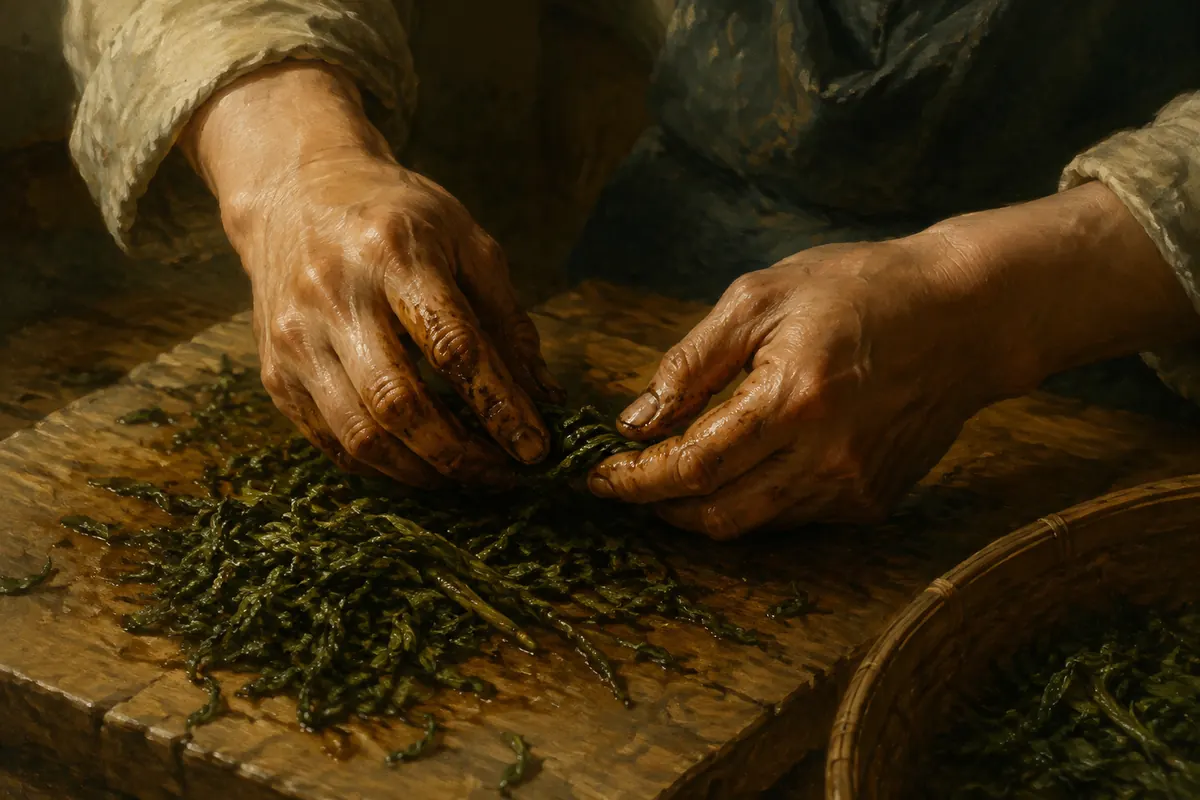
The overwhelming majority of Kenyan tea is made by the CTC method — crush, tear, curl. The leaf is shredded into hard uniform granules that oxidise fast and brew strong, dark and quickly. CTC is often dismissed by tea snobs, which is a mistake: it is a purpose-built technology and Kenya makes the best of it in the world. A good Kenyan CTC is the reason a builder's tea can be excellent.
But there is a growing orthodox and specialty sector worth knowing:
- Kenyan orthodox black — whole-leaf, rolled rather than shredded; brisk and clean with a distinctive coppery brightness.
- Purple tea — a Kenyan original. Bred over decades by the Tea Research Foundation of Kenya and released as cultivar TRFK 306, it produces leaves rich in anthocyanins, the pigments found in blueberries and red cabbage. It brews a pale purplish-pink liquor with a soft, slightly woody, low-astringency character, and it exists nowhere else at scale.
- Kenyan silver needle and white teas — small volumes, increasingly good, and dramatically cheaper than Chinese equivalents.

The numbers
| Measure | Kenya |
|---|---|
| Annual production (2024) | Approx. 599,000 tonnes |
| Share of world production | About 8% — third globally |
| Export rank | Largest tea exporter in the world |
| Smallholder share | Around 60%, via 500,000+ farmers |
| Tea introduced | 1903; commercial planting from 1924 |
| Harvest window | Year-round, every 7–14 days |
Kenya grows roughly one sixth of what China does. It exports more than China, and more than India — because both of those countries drink most of what they grow, and Kenya drinks relatively little of its own.
How to brew Kenyan tea
- Water: full boil, 100 °C / 212 °F.
- CTC: 2–2.5 g per 200 ml, 2–3 minutes. It extracts fast — over-steeping turns it harsh quickly.
- Orthodox: 2.5–3 g, 3–4 minutes.
- Purple tea: 85–90 °C, 3 minutes. A squeeze of lemon shifts the anthocyanins and turns the liquor noticeably pinker — a genuine chemistry demonstration in a cup.
- Milk: yes for black CTC and orthodox. No for purple or white.

Why East Africa deserves more respect
Kenyan tea has spent a century as an anonymous ingredient — the strength component in somebody else's blend, sold by the container-load and never by name. That is beginning to change, and the case for it is straightforward: reliable altitude, volcanic soil, year-round picking, serious agronomy, and a smallholder structure that puts money directly into rural hands.
Compare it honestly against Ceylon or a plainer Assam and the quality gap is far narrower than the price gap suggests.
Frequently asked questions
Is Kenya the world's largest tea producer?
No — Kenya is third in production, behind China and India, with about 599,000 tonnes in 2024. But Kenya is the world's largest tea exporter, because China and India consume most of what they grow while Kenya exports the great majority of its crop.
How is the Nile connected to Kenyan tea?
The White Nile flows out of Lake Victoria, and Kenya's main western tea belt — Kericho, Nandi Hills, Bomet and Kisii — drains westward into Lake Victoria. The remotest headwaters of the Nile system also rise in the tea-growing highlands of Rwanda and Burundi.
Why can Kenya harvest tea all year?
Kenya's tea grows almost exactly on the equator at 1,500 to 2,700 metres. Day length barely varies, altitude keeps temperatures moderate, and two rainy seasons supply reliable water, so the plant never goes dormant. Bushes are plucked every 7 to 14 days year-round.
What is Kenyan purple tea?
Purple tea is a Kenyan-bred cultivar, TRFK 306, developed by the Tea Research Foundation of Kenya. Its leaves are rich in anthocyanins — the pigments found in blueberries — and it brews a pale purplish-pink liquor with low astringency and a soft, slightly woody character. Adding lemon turns the liquor noticeably pinker.
What is CTC tea?
CTC stands for crush, tear, curl — a processing method that shreds tea leaf into hard uniform granules which oxidise quickly and brew fast, dark and strong. Most Kenyan tea is CTC, and it is the backbone of the global tea bag industry.
Who grows Kenya's tea?
Roughly 60% of Kenyan tea comes from smallholder farmers organised through the Kenya Tea Development Agency — over 500,000 growers, many farming just an acre or two, who deliver fresh leaf to collectively owned factories. The remainder comes from larger estates, concentrated around Kericho.
